“It’s 2021, and our movement has won,” Ulli Hussein Barta told a group of people gathered in a muted East Village basement last week. Thursday’s snowstorm, which had shut down public schools and closed businesses, had slowed to flurries as darkness fell. Inside Planeta, a community arts space on East Eighth Street near Avenue B, melted ice dripped down a pile of coats and scarves sitting atop a wooden table. “Close your eyes and imagine what that’s like.”
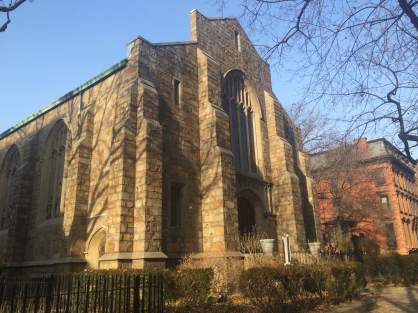
The Cadman Congregational Church, a 1920s building located in the Clinton Hill part of Brooklyn, has that old building smell — like dust and bit of mold — and stairs that creak as you walk up them. But past the pile of shoes at the entrance, the gymnasium of the old church has been completely transformed into a light, airy dance studio complete with a brand new sprung dance floor and freshly painted white walls.
The Cadman Congregational Church.
There’s no central heating, but a pile of blankets are left for people to wrap up in, and a group of dancers, puppeteers, actors, church members, and community members enter happily sock-footed, greeted by Pepper Fajans, who is a dancer, puppeteer, carpenter, and creator of the Brooklyn Studios for Dance.
“You are now in a process,” said Fajans, standing barefoot in the center of the cavernous church gymnasium-turned dance studio.
Dressed in a simple white t-shirt and tan carpenter pants, Fajans welcomed the audience to Co. Venture in Process, a preview of his show Co. Venture, which is a work of modern dance, puppetry, and storytelling done in partnership with 91-year-old dance archivist David Vaughan. Originally performed at the 2015 Montreal Fringe Festival, Fajans and Vaughan are revisiting the work to perform again this January at the Centaur Theater in Montreal.
After explaining that the giant wooden boards on either side of the room were representing the wings of a theater, Fajans slid a board slowly across the room, then let it fall forward silently to reveal Vaughan sitting in a chair. He began reading while Fajans danced, slowly balancing a board in the air.
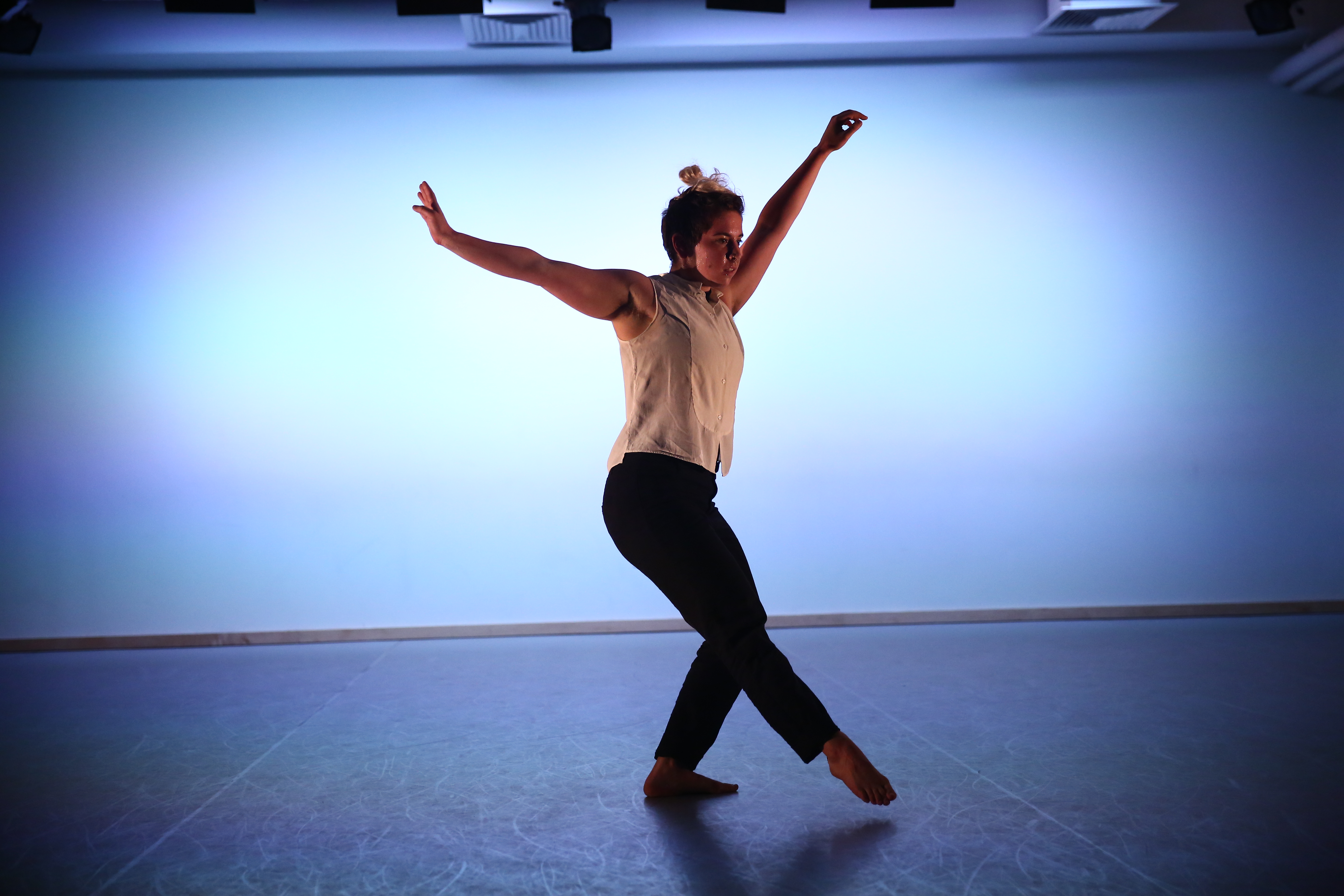
Pepper Fajans performing in “Co. Venture in Process”
At Brooklyn Studios for Dance, dance is much more than movement or technique, instead taking artistic collaboration and the involvement of the community to create a sustainable place where people can dance together.
“It’s about creating a physical community and a local community around dance, around assembly.” said Fajans. “We don’t have anywhere to assemble anymore. We don’t have community centers in the way that we once did, or in the way that this building once served. So I’m trying to return to a more classic definition of a community facility.”
Since opening in May, Brooklyn Studio for Dance’s main mission has been to educate, perform, and practice the art of dance, but Fajans says that his purpose right now is also to work in partnership with the church in order to secure the longevity of the space. This means investing in the building and the local area of Clinton Hill.
Though Fajans is not religious, his relationship with the church is one of a symbiotic nature. He is the janitor and sexton at Cadman Congregational and he uses his carpentry skills on the continual project of fixing up the building.
“Dance is my practice, call it spiritual, call it practical,” he said. “Members of the congregation take our classes, they advise us on how to relate to this local community, and they give us a great example of how trust and faith and love can be put into practice.”
The building’s fix-up is an ongoing task. Members of Brooklyn Studios for Dance work once or twice a week in the church’s garden, volunteers put up storm windows a few weeks ago, and the heating problem still remains to be solved. Just like Fajans’ dance, it’s all a process.
“It’s a totally old church space and now it totally looks new. And I feel sometimes it looks like a museum,” said Maiko Kikuchi, a puppeteer and artist who performed with Fajans and Vaughan in Co. Venture in Process. “It’s a really beautiful space and I really love to work here.”
What makes Brooklyn Studios for Dance special is that it isn’t just a bunch of dancers using a church for rehearsal, but an investment in the community. This can be as simple as Fajans using the local cafe for wifi and snacks, or as involved as hosting a swing dance social every Friday night for community and church members to meet dancers and get moving.
“The atmosphere is electric.”
At the end of their first season as a studio, Brooklyn Studios for Dance held a final performance and Christmas tree lighting ceremony with members of the Cadman Congregational Church.
I spoke to some members of the church and of Brooklyn Studios for Dance about what it’s like to share the space and and come together for events like the Christmas tree lighting:
“What am I going to make art about, really?”
Dancers in New York nowadays often use the Internet for their community space, fundraising on crowdsourcing sites and advertising their shows on Facebook. Brooklyn Studios for Dance has a website and a Facebook page, but Fajans emphasizes the importance of having a space for gathering. This allows dancers to get involved in the community they’re located at, and it gives them a place for artistic collaboration. Like in Fajans’ show Co. Venture, the dance created and showcased at Brooklyn Studios for Dance is often not just dance, but works that include multiple elements such as acting, live music, storytelling, conversations.
A dance choreographed by Hadar Ahuvia, performed at Brooklyn Studios for Dance.
In Co. Venture, even though Vaughan sits in a chair throughout the performance, he and Fajans move together, breathe together, and have a conversation — sometimes through actual speaking, other times through movements, or even just eye contact. Their connectedness shows the power of creating art in a team.
“What am I going to make art about, really? Am I just going to wake up one day and decide that I’m going to paint a painting? It’s not quite like that,” said Fajans. “I’m very interested in being inspired by others, in seeing the delight in others and seeing the fear in others.”
The audience was part of the collaboration as well, part of the “process” as Fajans called it. None of the audience members left immediately after the show, instead sticking around to drink wine donated by a local wine shop and talk to Fajans and Vaughan.
“It’s hard not to cry when I see it,” said Nick Lehane, who was seeing Co. Venture for the second time. “It’s incorporating elements that they’re both interested in. I guess that’s what good collaboration is.”
Collaboration could be the trick to keeping dance alive in a time when money to fund large companies simply does not exist any longer. Fajans and Vaughan met while working for the Merce Cunningham company, and they both witnessed it being shut down. Being a dancer in New York and Brooklyn is a constant struggle to find money, space and an audience — making dancers constantly question their own worth.
“Maybe a dancer is worth nothing, but maybe the collaborator is worth something,” said Fajans. “Dance is your practice and your skill set, but it’s in collaboration that it starts to create value.”
Just a few minutes before she leapt onto the Astroturf stage dressed as a bumblebee with bright red lipstick, Robin Cantrell, artistic director of Indelible Dance, was dressed in pre-show clothing–sweats, a shirt, some thick socks–and giving her audience members a quick PSA.
Robin Cantrell, Artistic Director of Indelible Dance, at her show “The City of Seasons” in September. Photo Credit: Darial Sneed
Besides welcoming everyone to Indelible Dance’s annual show, Cantrell explained to the audience that they could get up and get more drinks whenever they wanted, that they could stand up if the seats were too uncomfortable, or they could sit on the floor instead. She said that they could laugh if they found something funny, cry if they found something sad, clap or cheer if they felt moved to do so.
Then she disappeared behind a curtain and with the first few upbeat notes of Vivaldi’s Spring movement from “The Four Seasons,” Cantrell was fully transformed into a bumble bee, smiling, jumping, and twirling around the circular stage, “pollinating” the flowers with a pair of antennae sticking out of her short brown hair. The audience laughed; her happy energy was contagious.
“I think most of us spend most of the day sitting and looking at a flat screen. And so when you go to see a show and you pay money for it, it seems silly to do the exact same thing,” said Cantrell. “I want the audience to feel fully in something and that it’s a really exciting, enjoyable experience.”
After spending her beginning years as a performer dancing ballet, Cantrell decided to shed the pointe shoes and tutus–and the rigidity of the ballet technique–to delve into the world of modern and contemporary dance. She’s a teacher, a traveler, and a performer, but most of all she is a unique voice standing out in the New York City dance community.
“I remember being in kindergarten and telling everyone I was going to be a professional dancer, I was going to move to New York and I was going to marry Michael Jackson,” she said. “I’ll let you guess which two of those things happened.”
Originally from Minnesota, Cantrell, who is 35 years old, started dancing at the age of 2, attended a competition dance school throughout high school and then got her BFA in Ballet Performance from the University of Utah. After performing for the City Ballet of San Diego for a few years, she was “pretty bored of all the Swan Lake” and started taking modern dance classes.
Eventually Cantrell and a fellow dancer, Mira Cook, decided to put on a modern dance show in a coffee shop. Realizing modern dance and choreography was something she was passionate about, Cantrell moved to New York at her first job offer–which happened to be dancing for a company that did ballet to heavy metal.
Now, Cantrell dances for Battery Dance Company, a modern dance company of five dancers based in lower Manhattan that is largely funded by the state department.
Cantrell has the body of a dancer, thin but with the hidden muscle that comes from years of dance training, and a calm demeanor–results of the meditating and yoga she does regularly.
“She’s very rubbery,” said Cook, who has been dancing with Cantrell for 13 years. “She looks weightless, but not in a floating way. Some people have said that she looks like a puppet sometimes, like that her body moves itself without effort.”
Besides traveling, teaching, and performing with Battery Dance Company, Cantrell keeps her home life with her husband in Williamsburg as organized as possible so that she can be wildly creative when choreographing and coming up with ideas for shows.
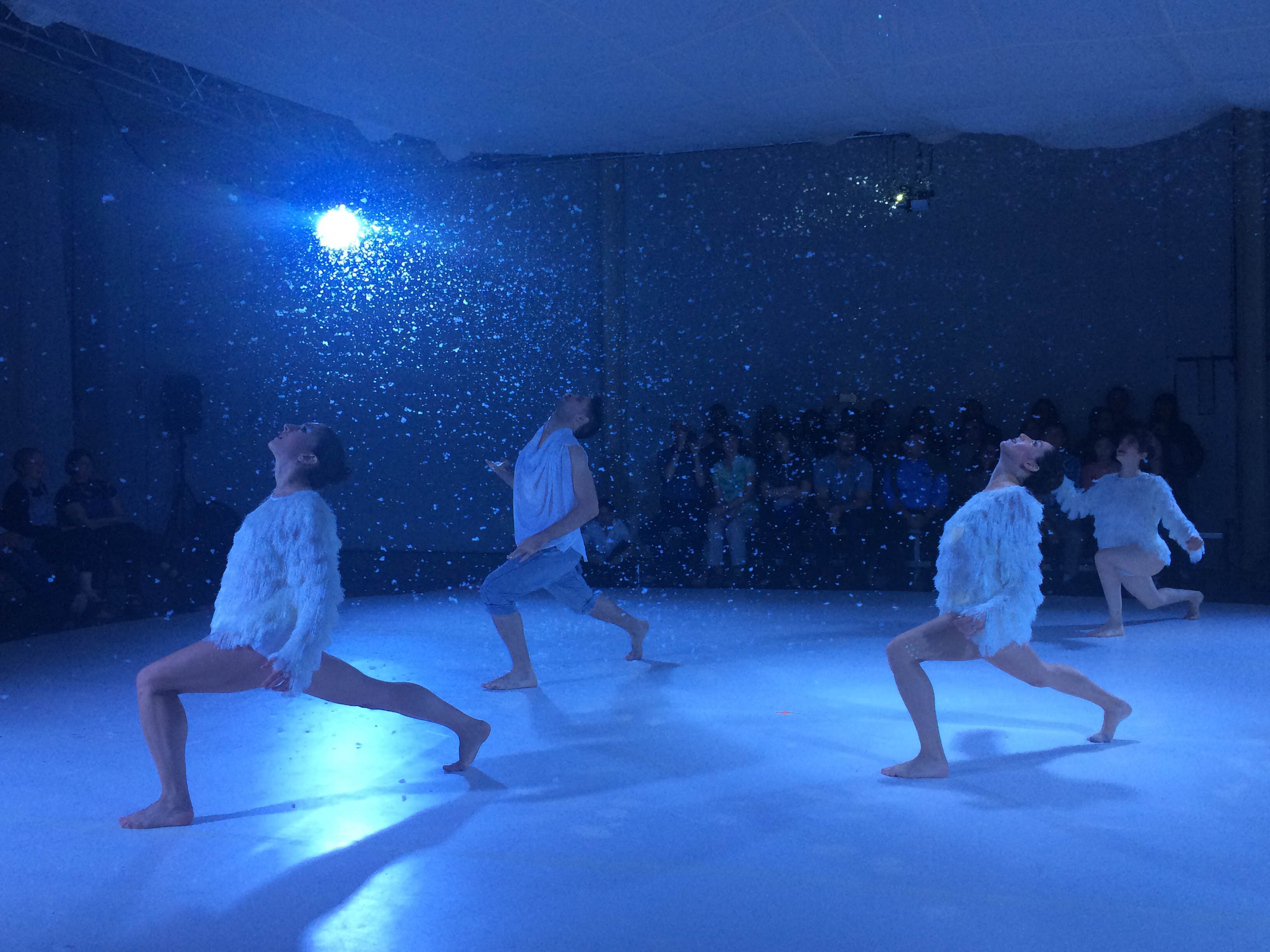
During the “Winter” part of Cantrell’s show, where snowflakes fell from the ceiling onto the dancers.
“Usually I think of the whole show at once in the shower, the moment the previous show ends,” she said, making the creative process sound incredibly easy.
The ideas might come easily to Cantrell, but putting together a show requires the collaborative effort of her entire company. While the dancing and choreography is the most important part, Cantrell also puts a lot of energy into figuring out ways to connect with the audience. For example, she never has shows in a traditional theater, opting instead for a more interactive layout, where the audience is at the same level as the dancers.
“She has a very good eye for the big picture of what she wants,” said Cook. “Having known her for a while, I see her exploring ideas that I know are themes in her life. So I think it’s kind of personal, but she takes it to a really fantastical place.”
Her show this September, called “The City of Seasons” took a twist on a classical piece by the baroque composer Vivaldi, including a pas de deux done under the spray of a hose during Spring, dancers serving ice cream to the audience during Summer, a fight over sweaters during Fall, and chilly fog and falling snowflakes during Winter. The special effects created palpable season changes for the audience, making the dancing that much more powerful.
For Cantrell, keeping dance alive means creating a connection with the audience and making them feel comfortable at a dance show. She especially tries to connect with a younger audience, those who aren’t necessarily interested in attending a more traditional ballet or dance show.
“A show is for the audience, you can’t do it in a vacuum. It’s for them, it should be entertaining,” said Cantrell. “Whether that entertaining is making someone horrified or laugh or cry or fall in love, you have to illicit something.”
To see Robin Cantrell and Mira Cook dance, check out duetproject.com
Sophie Sotsky, the artistic director and founder of the modern dance company, TYKE DANCE, is familiar with the trope of the “starving artist.”
“Everybody has a Kickstarter every week. It’s like, ‘Okay everyone, give your $15 to this person, then the next week it’s this person.’ And it’s the same dollar bill that’s just going around in a circle and nobody has any money,” she said.
Sophie Sotsky, artistic director of TYKE DANCE. Photo by Paula Court, courtesy of Gibney Dance.
With her curly hair cropped asymmetrically short, a septum piercing, and an array of layered clothing—which she gestures to when explaining how she “sucks” at creating dance costumes—Sotsky fits the part of an unconventional choreographer.
She says she’s still working on “codifying her movement vocabulary,” but since starting TYKE DANCE in 2011 Sotsky has been creating pieces that combine modern dance techniques and extreme athleticism. It’s a language that’s not always easy to understand.
“You know how when you see a Jackson Pollock painting, it’s actually just paint. The paint doesn’t represent something else, the subject matter and the materials are just the same: paint. That’s my dance. It’s about what’s physically happening,” she said.
The public’s inability to understand dance could be the reason it is one of the more underfunded art forms, and at a time when the cost of living in New York is at an extreme high, dance companies are constantly trying to find cheaper ways to continue making their art.
Sotsky combines modern dance techniques and extreme athleticism. Photo courtesy of Lindsay Keys.
According to Sotsky, the days of large donors giving money to dance companies are over, so dancers have to rely on crowd funding sites like indiegogo.com or kickstarter.com, which are platforms for online fundraising. But crowd funding can only be successful if donations are made from donors outside of the community, otherwise it becomes a cycle of the same ten dollars being passed from dancer to dancer, ultimately making the dance community more isolated.
“I worry that as an artist I have resigned myself to the fact that I will unquestioningly spend the rest of my life asking everyone I know for $10,” said Sotsky. “So I’m 26 and I’m not going to ask for that money until I know that this is the show of my career.”
Instead, Sotsky pays for all of her performances and projects out of pocket by working as a freelance electrical technician for nine different dance venues in Manhattan. She lives in an apartment building in Bushwick that has a rehearsal space she can use and she has a group of nine dancers willing to work with her for free.
Gregory Dolbashian, artistic director of the DASH Ensemble, a group of contemporary dancers based in Manhattan, thinks that people need to stop using the words “starving” and “artist” in the same sentence.
“You have to believe that the power is in your hands,” he said. “I think that there’s a lot of money in the city and there’s a million and one ways to get it.”
Dolbashian has been successful with Indiegogo campaigns in the past, but he says that the key is in the personal connections.
“I really try to actually be shaking hands and speaking with people as opposed to just typing on my computer,” he said, but he credited some of his success to the fact that he was born and raised in New York City, and therefore has lifetime relationships he can rely on.
Compared to other art forms such as music and film, funding for dance on crowdfunding sites is incredibly low. In 2014, around 4,000 music projects were funded on Kickstarter, but only 416 dance projects were funded.
One producer who is working on creating more opportunities for emerging artists is Alexis Convento, the founder of The Current Sessions, a performing arts organization that provides a space for choreographers and dance companies to perform.
The Current Sessions charges choreographers a production fee ranging from $125 to $150 and then provides rehearsal space, light design, sound design, and two performances at the Wild Project Theater in the East Village.
Convento enjoys being able to bring opportunities to emerging dancers; a group of people that she says are not ready to give up, despite the lack of funding.
“There’s this energy from the younger crowd to just keep on working even though it costs money,” she said. “When I was first starting work I had a bunch of part time jobs. I was maybe working two restaurants at times, which I know a lot of choreographers are doing now in order to sustain their artistic career.”
Not only do some dancers and choreographers work multiple jobs, but they also turn to alternative methods to stay fit because dance training classes are often too expensive.
“People are taking donation based yoga classes or people are training with their friends or becoming gyrotonic certified, or pilates certified,” said Convento. “It’s been difficult, but there are definitely ways of people coming together.”
Sotsky, who has worked with Convento and The Current Sessions before, has seen this energy in the dance community as well. It’s what keeps her working hard to make her art.
“I think that’s part of what makes the community so amazing to me,” she said. “Everybody here knows that we’re all going to be living in relative poverty for the foreseeable future and yet we choose it every day anyway. And I’m totally in love with that.”
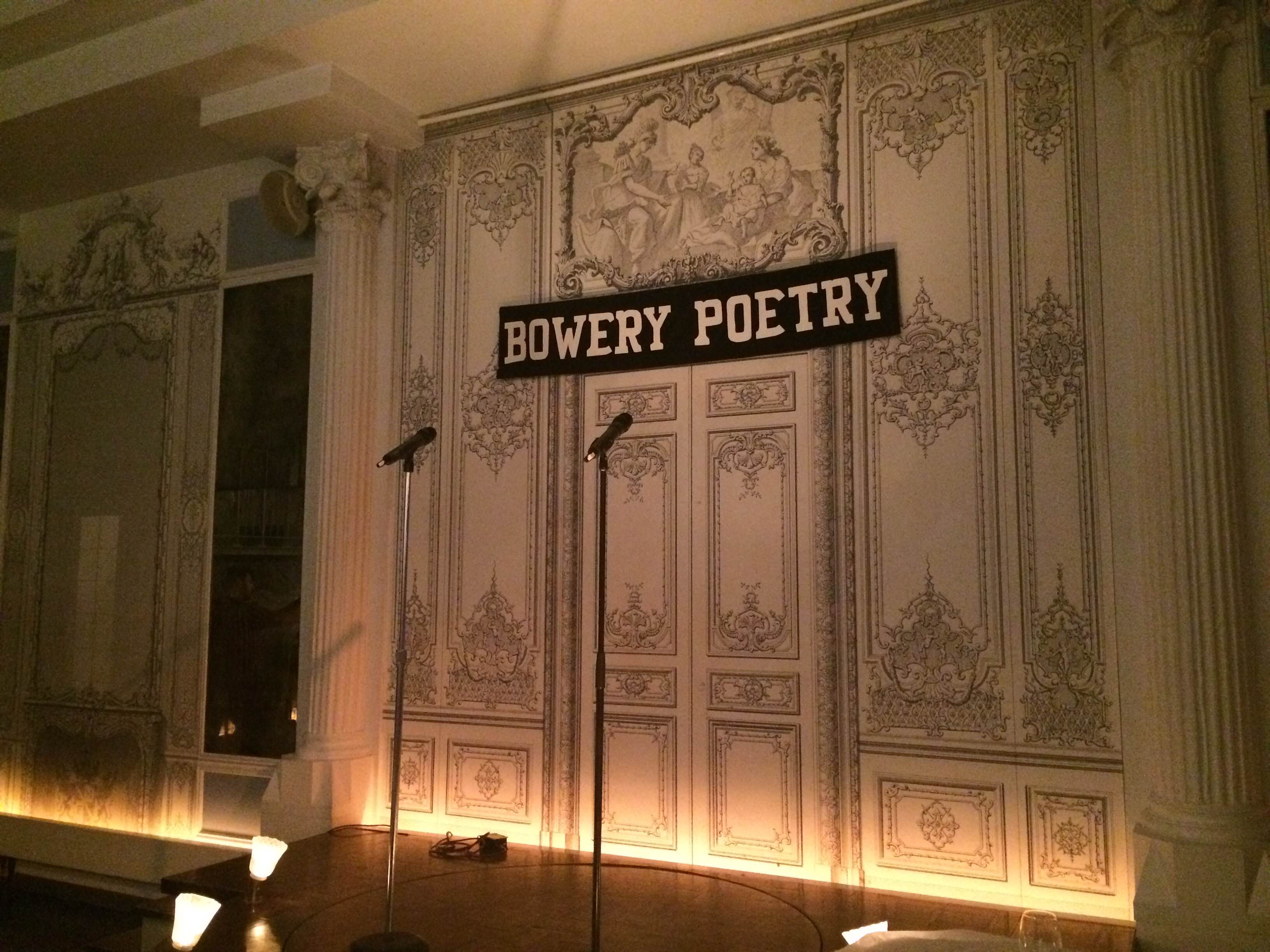
Every Monday night poets gather at 308 Bowery, not in a low-lit, dingy bar that one might expect for New York poets to hang out in, but in a room that has high ceilings, a glittering chandelier, and fancy French rococo-style wallpaper.
The décor might seem too extravagant for the starving poets of the lower east side, but since its foundation by the American poet Bob Holman in 2002, this space—called The Bowery Poetry Club—has become one of the few places in New York where aspiring poets can come together and share their work.
On Sundays and Mondays, poets and musicians take over the Burlesque stage.
“When it opened it was very much the quintessential bohemian dive poetry club, with exposed brick walls and sticky floors,” said Executive Director of Bowery Poetry Nikhil Melnechuk. “It really had a sense of both the eclectic and impoverished nature of poets.”
In 2012 the Bowery Poetry Club became a non-profit organization called Bowery Arts & Science. The space was renovated and rented out to a Burlesque club for 5 days of the week—hence the extravagant furnishings. Now, Bowery Poetry hosts open mics for poetry and music, as well as poetry workshops and reading nights.
“It has weight to it, to be able to say, ‘I’m performing at the Bowery Poetry Club.’ It holds a prestige to it,” said Ariel Yelen, who works alongside Melnechuk as the community manager.
On Monday nights, Bowery Poetry hosts “The Poet In New York,” which features a reading from a published poet—they have featured Eliot Weinberger, Forrest Gander, Eileen Myles, Adam Fitzgerald, and many more—followed by ten open mic spots.
“Poetry encompasses a lot, so it’s very generous in what it considers to be part of its community,” said Yelen. “ [Open mics] bring people from every kind of background and different communities a chance to be at the mic and be a part of it, not just watching it.”
Not only does Bowery Poetry allow new poets to read their work to an audience, but it also provides a place for poets to meet other poets.
“I think poets are masochists. They love a challenge, and they also are loners who are desperate to find people like them,” Melnechuk said.
Becoming a non-profit organization has allowed Bowery Poetry to focus more on keeping poetry and the arts alive in the East Village, a place that has recently become too expensive for many art and cultural spaces.
Bowery Poetry charges $10 at the door for most of their events, relying on ticket revenue and grants to be financially sustainable.
“Now that we’re a non-profit we have a sustainable model, so we’re here. We’re here to stay,” Melnechuk said. “And that’s been something that the community really is happy about.”
Future plans at Bowery Poetry include starting a slam poetry team, creating poetry videos for the web, and possibly opening a pop-up space in Brooklyn.
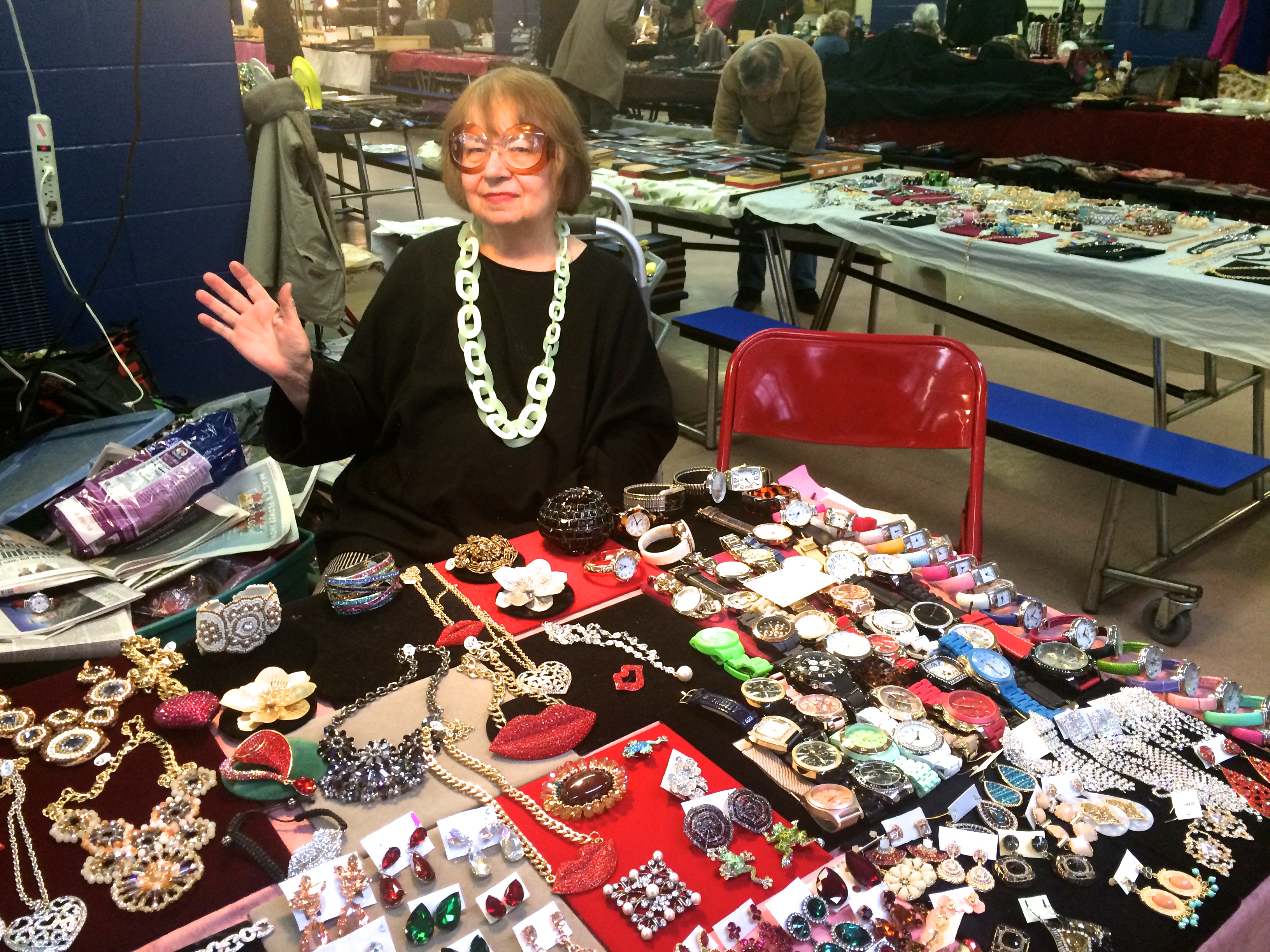
Marjorie Mortensen, a 78-year-old vendor at the GreenFlea Market on the Upper West Side of Manhattan, offers much more than the jewelry she has displayed at her booth. She’ll trade jokes, give restaurant recommendations, and tell stories about some of the fascinating people she’s met being a flea market vendor for 30 years, all while styling some of her costume jewelry and a fun pair of glasses.
Lily: What do you specialize in selling here at the flea market?
Marjorie: I sell all costume jewelry, which means no gold, no silver. I buy every piece myself; I don’t buy anything without having it in my hand. And I buy too much. I’m having a half price sale because I got carried away with buying.
L: Do you have any favorite pieces you’re selling right now?
M: Well I don’t buy anything I don’t like. Very often I’m several months ahead of the trends. And people will see something and go “what’s that?” and then later they come back and say “I saw this and then I saw it in a magazine and do you still have it?”
L: Can you tell me a little bit about the community of flea market vendors?
M: A lot of vendors like me are retirees trying to do something interesting and get out there and meet people and enjoy a day … Some people have said to me, because I’m disabled, they’ll say, “Oh you don’t go out enough, you have to get out and meet people.” Well I sit here on my bottom all day and I meet people from at least 10 or 15 countries a day and they come back, you know. Some people come back after two years or something.
L: Do you have any advice for first time flea market goers?
M: Don’t start the day with 100 dollar bills. Bring small bills, that way if you want something you don’t have to ask for a huge amount of change. And respect the vendor. There are articles of how to shop at a flea market, like in Women’s Magazines that say “don’t pay the price, offer half” you know, and then pretend you’re walking away. It’s stupid and people try that sometimes.
L: You mentioned when I first introduced myself that you used to be a writer?
M: I wrote for the mayor for 17 years. I put on events as an event planner and I wrote the Mayor’s proclamations.
L: How did you transition into selling jewelry at flea markets after being a writer?
M: I did this for a hobby. I was a founder of an organization and was putting on a lot of bazaars… I had to pay the bills for that, it was what I was doing in addition to my job…and I did street fairs to get money for the organization and then I liked it, I liked meeting people.
L: What was the organization you founded?
M: It’s called the Tibet Center. We started it in the early 70’s when hardly anyone had heard of Tibet. And it’s still going in a different format today. At that time, Tibet was closed and nobody could come in or out. The papers wouldn’t write about Tibet because that was controversial to them and so I would do a bazaar and I’d write a whole press release about the bazaar, that we’re selling things and selling Tibetan food and then at the end I would put, “there are only 22 Tibetans in New York because the country is closed” and then they would put it in the paper. I did a dinner one time, cooking Tibetan food and a lot of restaurant and food people came. James Beard came.
M: I’ve met people from every country except some of the countries in Africa… One of my customers turned out to be one of the leaders of the civil rights movement and I didn’t even know until he died and it was in the paper. And we used to see Andy Warhol almost every Sunday… You know there’s a lot of people that you know what their name is, but you don’t know what they look like. In New York, you never know who that somebody is. New York is small. Go see Marjorie at the GreenFlea Market at 100 W. 77th St. Open every Sunday from 10 a.m. to 5:30 p.m.








 Lily Haight